Mystic Rectangle
The Harmony Hidden in Contrasts
What is a mystic rectangle in astrology?
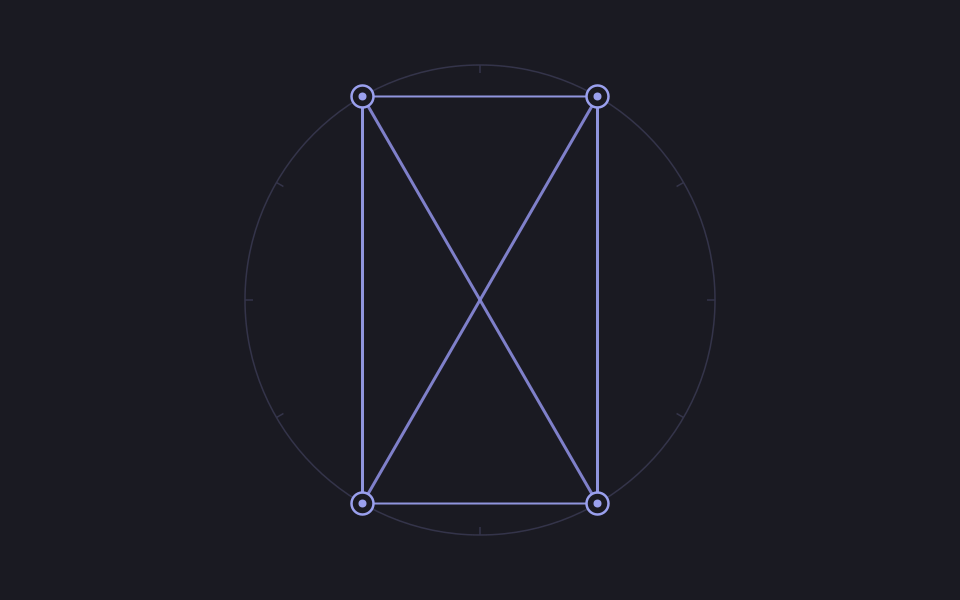
A mystic rectangle is an aspect pattern of four planets: two oppositions, with each end of those oppositions tied to the others by a sextile (60°) and a trine (120°), so the lines form a rectangle — sometimes nicknamed the envelope. The oppositions supply the argument; the trines and sextiles supply a usable route around it. The result is not a life without conflict. It is a life that can spend conflict, turning a polarity into work, craft, or a way of holding two truths without splitting. Like the Yod, this is a modern aspect-pattern, not a Hellenistic time-lord figure. Treat it as geometry, not a spiritual rank. Cast the chart in the birth chart calculator and check the four corners before you name it.
How do you identify a mystic rectangle?
You need four occupied corners and all six lines. Missing a trine, or stretching an opposition past a tight orb, collapses the figure into two leftover aspects. Elements usually pair as fire–air or earth–water; mixed elements can still count if the angles are exact, but the “feel” of the pattern follows the elements more than the name.
| Line | Angle | Job in the pattern |
|---|---|---|
| Two oppositions | 180° | The two arguments — the places the native cannot pick only one side. |
| Two trines | 120° | The long, easy sides. Talent and luck sit here; they can hide the work the oppositions still demand. |
| Two sextiles | 60° | The short sides. Practical cooperation; the “I know a way through” links. |
If you only have one opposition braced by trines, look at a grand trine or a kite, not this page. For any single pair, use the aspects reference. Dignity and reception still decide which corner can actually host the others. Keep oppositions inside about 6° and the trines/sextiles inside 4°; a sloppy box is usually two aspects and a wish.
What does a mystic rectangle feel like to live with?
The gift is integration you can use on a Tuesday. A person with a clear rectangle often mediates, designs, teaches, or repairs systems because they can see both ends of an argument and the path between them. Friends borrow their calm. The hidden cost is delay: the trines make it possible to stay pleasant and competent while the oppositions go unchosen. The pattern does not explode like a T-square. It silts up. Projects stall at 80%. Relationships stay “fine.” The native looks balanced from outside and slightly absent to themselves. That is why older texts that bother with the figure talk about practical spirituality rather than drama. The work is to pick a side of each opposition long enough to make something, then use the trine to refine it — not to live forever in the middle as a translator for everyone else.
How do the elements color the rectangle?
| Element pair | What the corners argue about | What the easy sides are good for |
|---|---|---|
| Fire and air | Will versus idea; courage versus the story about courage. | Speech, teaching, campaigns, art that moves a room. The risk is talk that never lands in a body or a deadline. |
| Earth and water | Need versus provision; feeling versus the job that pays for feeling. | Care, craft, money-and-home logistics, counseling with homework. The risk is becoming the reliable one who never asks. |
Read the houses of the four corners before you lean on the element story. An earth–water rectangle across the 2nd and 8th is a money-and-trust life; the same elements across the 4th and 10th is home versus vocation. The topic method still applies: planets in the houses, rulers, reception, outcome.
How do you work with a mystic rectangle?
- Write the two oppositions as sentences, not glyphs. “My Moon in the 4th wants a closed door; my Saturn in the 10th wants a public standard.”
- Name one trine as a tool you already over-use, and one sextile as a tool you under-use. Spend a month on the under-used side.
- Make a finished thing that requires both ends of one opposition — a piece of writing, a boundary, a product. The pattern ripens in output, not in insight.
- When a transit hits a corner, expect the old argument back. That is a working season, not a failure of the “harmonious” figure.
How is this different from a grand cross?
A grand cross is four squares and two oppositions — all hard, no padding. Life keeps forcing a choice. A mystic rectangle keeps the two oppositions and replaces the squares with trines and sextiles, so the same polarity arrives with a staircase. People confuse the two because both are four-corner boxes on a wheel. The test is the sides: if the short and long sides are 90°, it is a cross; if they are 60° and 120°, it is this figure. The lived difference is pace. The cross breaks things. The rectangle lets you postpone the break until the work is overdue. Read the two opposition axes as the real topics — 1st/7th is self versus other, 2nd/8th is mine versus ours, 4th/10th is private versus public, 6th/12th is the job versus the thing the job cannot name. Then ask which trine you have been using as a sedative. That is usually the line to retire for a season so the opposition can finish a sentence.
Related patterns
A Yod is a different triangle: two quincunxes and a sextile, one apex, no opposition. A grand trine has three trines and no built-in argument. A T-square has the argument and almost none of the padding. If several of these sit in one chart, start from the chart ruler and the angles, then decide which pattern is actually running the week. How to read a birth chart keeps the whole map in view.
Free Tool
Calculate your birth chart
Turn these archetypes into your own sky — planets, houses, and aspects, free.
Open the CalculatorRelated in Aspect Patterns