Yod Aspect
The Finger of Fate Pointing Toward Transformation
What is a Yod in astrology?
A Yod is an aspect pattern formed when two planets sit in sextile (60°) and both make a quincunx (150°) to a third planet at the apex, drawing a long, narrow isosceles triangle. Modern astrologers call it the Finger of Fate or Finger of God because the geometry points: the apex planet is where the chart keeps applying pressure, asking for adjustment that the two base planets can support but cannot finish on their own. It is not a Hellenistic figure — you will not find it in the older time-lord corpus — and it is not a prediction that “destiny will strike.” It is a map of a repeated misfit: two skills that get along, aimed at a third placement that never quite feels like the right size.
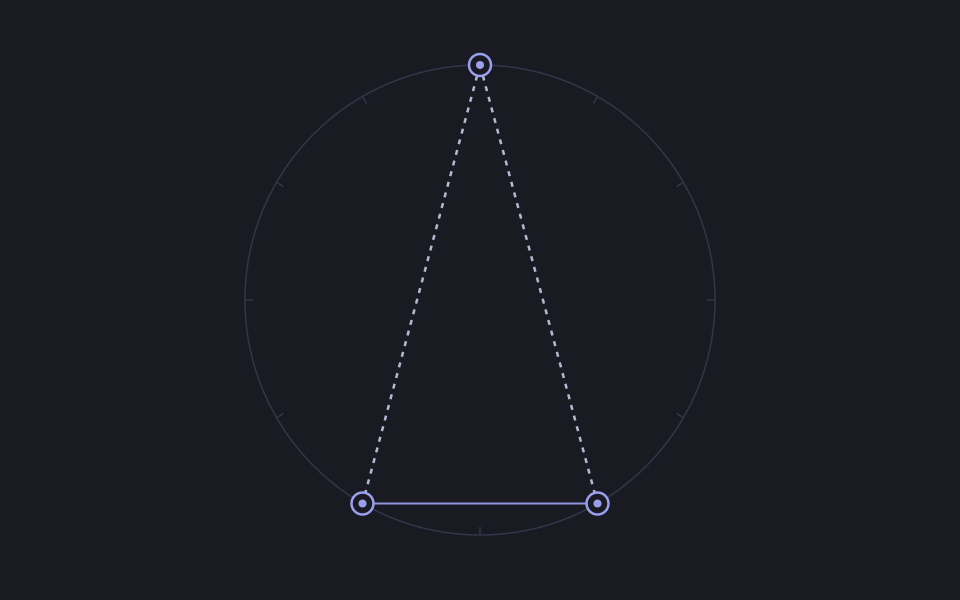
If you want the shape in your own chart, cast it with the free birth chart calculator and look for that skinny triangle. The rest of this page is how to read the one you find — or how to tell that you do not have one.
How do you identify a Yod?
Three conditions have to hold at once. Drop any one of them and you have a different pattern — a lonely quincunx, a sextile with no focus, or a triangle that is actually a grand trine or a wedge. Orbs should stay tight; a Yod built on 8° slop is usually just three planets that happen to sit nearby.
| Piece | Angle | What it does |
|---|---|---|
| Base pair | Sextile, 60° | Two planets that cooperate — talent, tools, a working alliance. |
| Two quincunxes | 150° each | Both base planets strain toward the same third planet. The 150° is the “almost, but not quite” aspect: adjacent elements, no shared modality, constant adjustment. |
| Apex planet | Focus of both quincunxes | The life area that will not stay settled until the base pair is used in its service. |
A quincunx is five signs apart (Aries–Virgo, Taurus–Libra, and so on). If one “quincunx” is actually 140° or 165°, it is not a Yod. If the base is a trine rather than a sextile, look at other aspect patterns instead. For the grammar of any single aspect, start from the aspects hub.
What does a Yod feel like to live with?
People with a clear Yod often describe a life that will not let them stay in the comfortable job the sextile describes. The base planets are good at what they do — writing and teaching, craft and care, strategy and timing — and those two can keep a person busy for years. The apex, though, keeps interrupting: a health crisis, a relocation, a role that does not match the resume, a relationship that will not run on the old script. The interruption is not random. It lands on the house and sign of the apex, and it repeats until the person spends the base talents on that problem instead of around it.
That is why the pattern picked up a fate vocabulary. The chart is not choosing a profession for you. It is marking a place where ordinary compromise fails, so the native either keeps rearranging furniture in the same room or finally walks through the door the apex has been pointing at. Delayed clarity is normal. Many Yod stories make sense only in the thirties or later, once a few failed “almost” versions have piled up.
How do you read the apex planet?
Read the apex the way you would read any other planet: its sign (style), its house (life area), its dignity, and whether anyone receives it. Then add the Yod-specific question: what must this planet become that the two base planets are already equipped to fund?
| Apex | The pressure usually sounds like |
|---|---|
| Sun | Identity will not stay borrowed. The person is pushed to occupy a role that looks unlike the family or the peer group, and the chart will not let a false self hold. |
| Moon | Safety and belonging keep being rewritten. Home, family, and the body become the classroom; caretaking others is not a substitute for feeding the Moon’s actual need. |
| Mercury | The voice, the craft of thinking, or the trade itself has to change form. An old way of explaining the world stops working. |
| Venus | Taste, love, and what one will pay for will not stay conventional. Relationships and values are the adjustment zone. |
| Mars | Will and anger have no polite outlet until they are aimed. Action, conflict, and desire become the mission, not the embarrassment. |
| Jupiter | Belief, teaching, or travel will not stay local. The person is asked to stand for a larger meaning than the base talents first suggested. |
| Saturn | Duty arrives before confidence. Authority is earned the long way; skipping the apprenticeship keeps the quincunxes raw. |
| Uranus, Neptune, Pluto | An outer-planet apex makes the “mission” less personal and more collective — a break with the given world, a spiritual or artistic calling, or a transformation other people feel too. See modern vs classical. |
Do not stop at the planet’s name. A Saturn apex in the 10th is a different life from Saturn in the 4th. A debilitated apex with no reception is harder to inhabit than one a benefics will host. The Yod names the geometry; reading a topic still does the weighing.
What are the two base planets for?
They are the toolkit, not the problem. A Mercury–Venus sextile at the base is language plus taste; a Mars–Jupiter sextile is drive plus reach. Those two already know how to work together — that is what a sextile is. The mistake is to treat them as the whole chart and ignore the apex, or to treat the apex as a curse and try to live only in the sextile. The pattern works when the alliance is spent on the apex house: the writer-and-teacher pair used to rebuild a public role; the craft-and-care pair used to hold a family through a move they did not choose. If the base planets are in reception with the apex, the adjustment is kinder — someone in the chart is willing to host the misfit. If they are not, the native supplies the hospitality by hand: training, therapy, a second skill, a long apprenticeship.
Is a Yod rare, and is it “special”?
It is uncommon compared with a single square, and less uncommon than marketing copy claims. Plenty of charts have one sloppy triangle that is not a Yod once you tighten the orbs. Plenty of lives feel fated without this geometry. Do not promote the pattern into a personality type. Read it as one structure among others — next to a T-square, a bundle, the chart ruler, the sect of the chart. If the apex is also the chart ruler, or sits on an angle, the Yod is louder. If it is a cadent out-of-sect Saturn with no reception, it is still real, but it is not the only story.
How do you work with a Yod, practically?
- Name the apex in plain speech: planet, sign, house. One sentence. “Saturn in the 10th wants a public standard I keep dodging.”
- Name the base pair as resources, not hobbies. What can those two already do without strain?
- Look for the last three times life forced the apex issue. If the same house keeps lighting up, you are not imagining it.
- Spend the base pair on that house for a season — a project, a course, a conversation — and see whether the restlessness changes. A Yod eases when the apex is used, not when it is explained.
- Time it. A transit or a firdaria period to the apex is when the “nudge” becomes a shove. That is when the journal prompts are worth more than theory.
Italian and English searchers asking come fare lo yod / “how to do a Yod” are usually asking this section: how to spot it and how to live it, not how to draw a pretty triangle.
Related patterns and next reads
If the triangle is wide and easy, check a grand trine. If two oppositions are braced by trines and sextiles, that is a mystic rectangle. If three planets square and oppose, start with the T-square. Then go back to the whole chart — how to read a birth chart — so one pattern does not swallow the reading.
A note on orbs and false Yods
Most “I think I have a Yod” charts do not. One quincunx plus a wide sextile is a mood, not a pattern. Keep the sextile inside 4° and the quincunxes inside 3° unless a luminary or a very strong planet is involved; if you have to argue for the third line, drop the name and read the two aspects you actually have. A false Yod wastes the reading. A real one is already loud enough without extra mythology.
Free Tool
Calculate your birth chart
Turn these archetypes into your own sky — planets, houses, and aspects, free.
Open the CalculatorRelated in Aspect Patterns